Tuesday, December 10, 2013

Magical Maastricht

The Maastricht Christmas Market

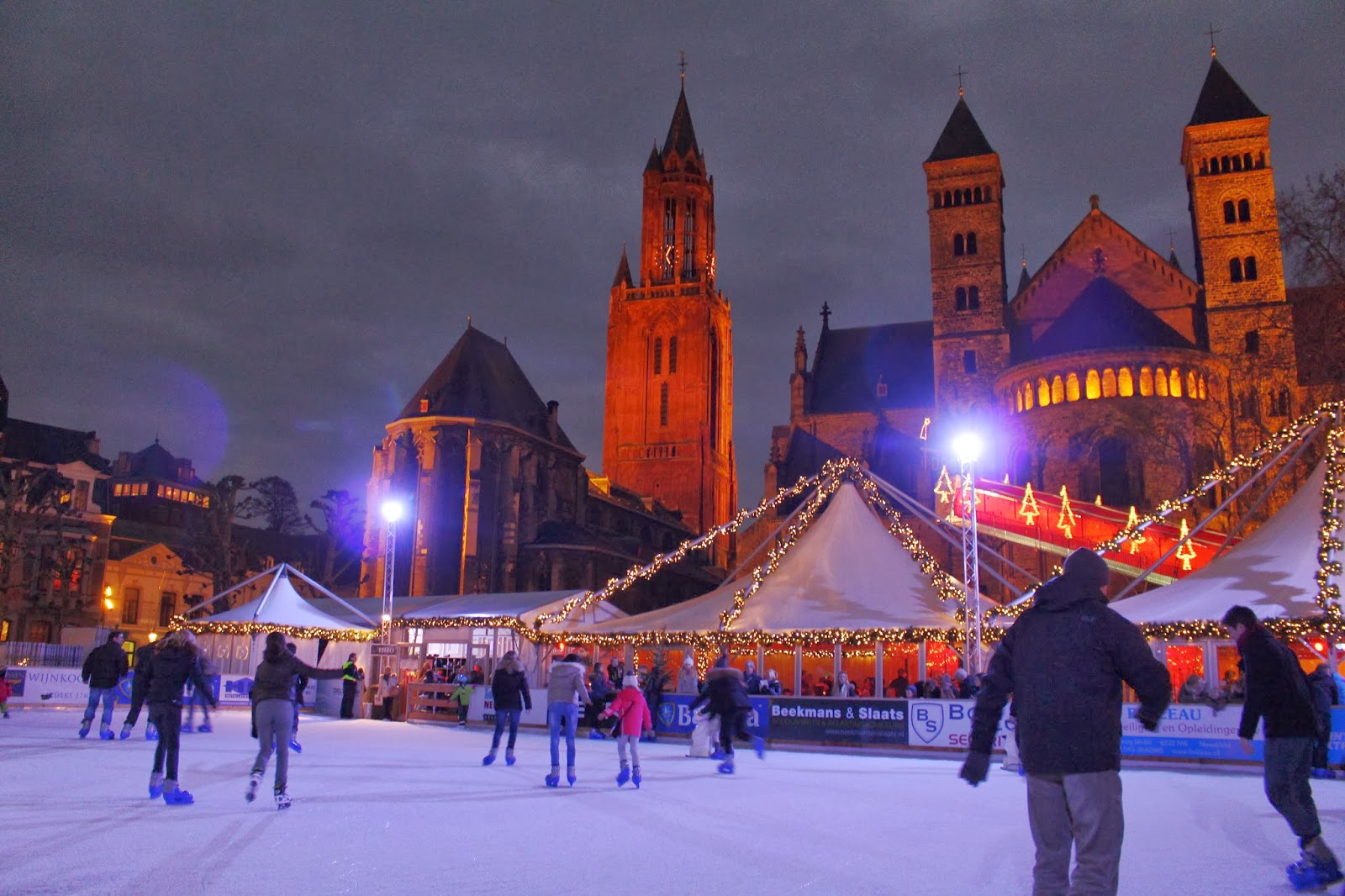
Maastricht is all dressed up for the Holiday Season. Garlands of greenery and lights festoon the streets. The Vrijthof has been transformed into a winter wonderland, complete with an ice skating rink. The little white Weinachtsmarkt houses that are set up in the square are selling unusual items from around the world.

There are carnival rides for the kids, too. A brightly lit Ferris wheel competes with the surrounding ancient buildings for attention. 

I convinced Jim to go for a ride on that huge Ferris wheel. The view from the top was so wonderful! From up there the cafes that line the western side of the Vrijthof look like a miniature rainbow row. 

Skating under the gaze of the Sint-Jan and Sint-Servaas churches.

Ralph & Co.
The skating rink below the two magnificent churches on the Vrijthof is a popular place. We met our neighbor Ralph and his 3 sons at the skating rink. These are Dutch kids, and they can skate! 
Everyone seems to be having a good time at the Christmas Market. Around the square and in nearby streets there are beautiful little food stands decorated with hand-painted designs. They're selling all kinds of fast food: potato fritters, pannekoeken (crepe-like pancakes), poffertjes (small, fluffy pancakes made with yeast and buckwheat flour), frites (served with mayo), bratwurst, bitterballen (deep fried breadcrumb coated balls with gooey mystery meat/spice mix inside), champignons (mushrooms), belgian waffles with whipped cream, plus lots of stands selling a variety of deep fried doughnut treats called oliebollen, some custard-filled. All very tempting, but heartburn-inducing foods for Jim and me, so we stayed away...
But we did indulge in the Magical Maastricht glühwein…because we wanted the souvenir cup, of course!

Monday, December 9, 2013

Onze Lieve Vrouweplein by Night

Onze Lieve Vrouweplein is most beautiful in the evening.


It gets dark early here at this time of year. But Maastricht makes up for the long hours of darkness by lighting up in some creative ways at night. White lights are strung in many different forms throughout the city center. On Onze Lieve Vrouweplein (the Square of Our Lady) there are light garlands strung across the street, and ball-shaped clusters of white lights suspended over outdoor restaurant tables on the square's central terrace. 

At the southern end of the square the huge towers and westwork of the Basilica of Onze Lieve Vrouweplein glow golden in the floodlights (the westwork is the monumental wall between the towers). Most of this Romanesque church was built in the 11th and 12th centuries. It's a Roman Catholic parish church, also known as the Sterre der Zee church (Star of the Sea). 


The main attraction in this beautiful church is a tiny gem of a chapel located to the left of the westwork. The chapel is home to a lovely little 15th century wooden statue of the Virgin Mary, Our Lady Star of the Sea. The gold inscription on the arched entrance to the chapel urges people not to pass by without saying a prayer to Our Lady. It's an inviting place, especially late in the evening, when you can often be all alone with the little lady. There are so many votive candles lit on the rack in front of the statue that you can feel the warmth of the many tiny flames- a gezellig sensation on a cold winter night. I've lit a few candles in this sacred corner of Maastricht. It's one of my favorite places in this wonderful city.


A number of nice cafes with outdoor tables line the western side of the square, and at the northern end of the square the Wolfstraat begins. It's a pedestrian only shopping street that is just east of the original path of the Roman road that existed here in the first century AD. 


It's nice to go for a walk after dinner in Maastricht. Sometimes we'll stop at a cafe called De Comedie along the way. It's at the corner of Wolfstraat, at the northern end of Onze Lieve Vrouweplein. 


A little table under De Comedie's awning (warmed by heat lamps at this time of year) is the perfect place to have coffee and a Dame Blanche for dessert. That's Jim's favorite- vanilla ice cream with chocolate sauce and whipped cream. Tonight I ordered cappuccino and appelvlaai met slagroom- (apple tart with whipped cream). And Jim ordered a beer with his Dame Blanche!


From the Vrouweplein we walk back to the apartment via Koestraat and Bisschopsmolen. Usually these narrow pedestrian streets are bustling with activity, day and night. But on this rainy Monday evening all is quiet. On Mondays most of the shops and restaurants in this little corner are closed. But buildings are lit and flags are up, reminding us that the street will be open for business and welcoming us back tomorrow.

Thursday, December 5, 2013

A Day in the Palatinate

Theresianstrasse, Rhodt unter Rietburg.

Martin took this beautiful photo of
a Rhodt unter Rietburg vineyard.


In mid October Jim and I went to visit our friends Martin and Benedicte (and their very cool 13 year-old son, Adrien) who live near Heidelberg, Germany.  


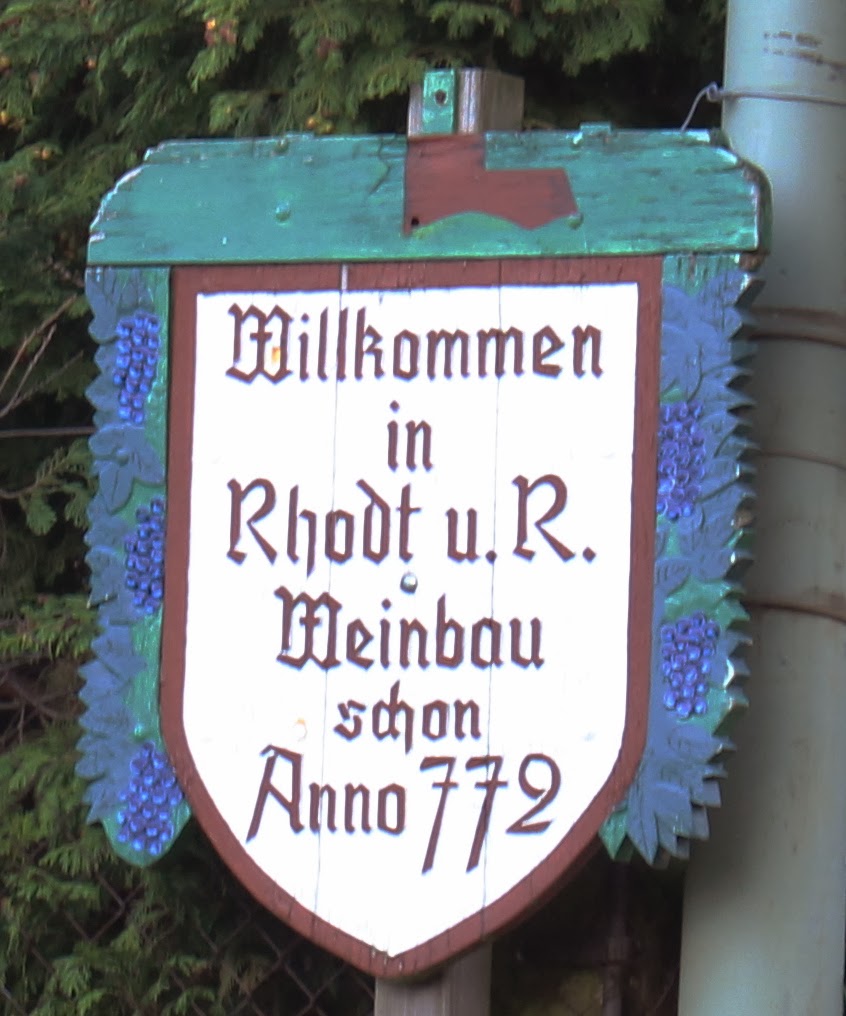
On the last day of our visit they took us for a drive on the Deutsche Weinstrasse (German Wine Route) in the Palatinate region. Many of the Pennsylvania Dutch who live in the USA are descended from German Palatines who emigrated to America in the early decades of the 18th century. We stopped in a beautiful little village named Rhodt unter Rietburg. The hillsides surrounding Rhodt were covered with grapevines, of course, creating some beautiful scenery.


It was a cool autumn day, a nice day for a walk up the village's Theresianstrasse, which is lined with many beautiful old houses. High above the village, off in the distance, we could see the remains of Rietburg Castle. Thus the name Rhodt unter (under) Reitburg. The village has been making wine for over 1200 years, so grapevines in one form or another adorn many of the homes. 


We also saw empty wine bottles suspended from a leafless tree in front of one house, a Palatinate spirit tree of sorts! 


The Palatine's Neuer Wein was in season, so we stopped to try some in one of the several tasting rooms in the town. It was a refreshing, sweet wine- slightly fizzy. Neuer Wine goes down easily, almost like drinking a white grape soda. 


Our friends: Benedicte and Adrien (my godson); Martin holding Ed, and Moe on his favorite perch!
We had spent a very pleasant October weekend with Martin and Benedicte and Adrien (and their very sweet cats, who were also very nice to us). Our autumn stroll in Rhodt under Rietburg was a nice way to wrap up our visit.


Rothenburg ob der Tauber: Everything Christmas

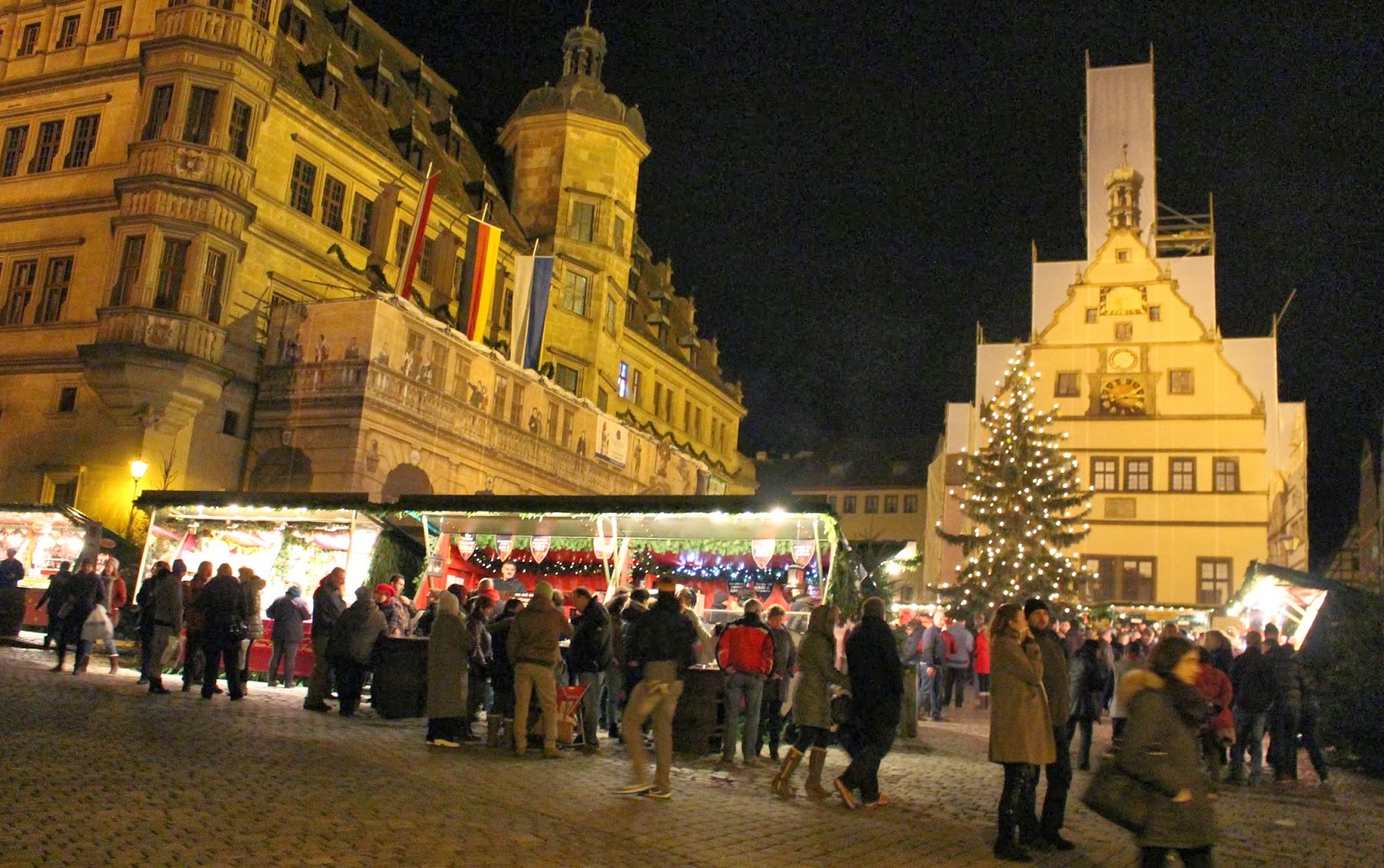
Christmas Market stalls in the Marktplatz, Rothenburg


Rothenburg ob der Tauber is the quintessential German Christmas town. Many of its stores are of the "all Christmas all the time" variety. There must be millions of Christmas ornaments and decorations for sale in this beautiful little place.


The Herrngasse decorated for Christmas.
Knussknackers (Nutcrackers)
in a shop window

The town's old buildings are all decked out for the holiday. Tiny fresh evergreen trees strung with lights hang above entrances on the Herrngasse, and the shop windows are filled with Christmas goodies.


Käthe Wohlfahrt: all you need for Christmas, and more!


The Mother of all Christmas stores, Kathe Wohlfahrt, has its headquarters in Rothenburg. The company's flagship store near Rothenburg's Marktplatz (Market Square) is conveniently located next door to the Weihnachtsmuseum- the Christmas Museum. No coincidence, because Kathe Wohlfahrt owns the Christmas Museum. 

An aisle of ornaments in the Kathe Wohlfahrt store.
But the Kathe Wohlfahrt store itself could be a museum. It has just about every type of Christmas themed object imaginable for sale, including the largest selection of traditional German Christmas ornaments in the world- more than 30,000 of them!


Beautiful items for sale in the Weinachtsmarkt stalls.
Benedicte and I spent two wonderful days together in Rothenburg. We chose to avoid the many museums in town. Instead we visited the shops, and also the stalls of the Weinachtsmarkt (Christmas Market) that were clustered in different areas of the town center. We stopped to drink hot glühwein in the Marktplatz, of course, for a nice break between browsing the Weinachtsmarkt stalls.  


My fashionable french friend Benedicte in her new hat.
Benedicte's favorite shop here, Anra Mode (www.anramode.de), sells very cool clothing that is handmade on the premises. She bought a beautiful felt hat with two flowers on it (also made of felt), a great souvenir of her visit to Rothenburg.  


The Markusturm (Mark's Tower) after dark.
On Sunday evening we joined the Night Watchman's Tour. Rothenburg's modern-day Night Watchman is Hans Georg Baumgartner, a very entertaining guy who gives a great tour. He was dressed in a long cloak and carried a lantern and a hellebarde (a weapon-topped staff, necessary in the old days to protect a Watchman from town drunks and thieves). The town was beautiful at night. It was fun following the Watchman around on the cobblestone streets, hearing snippets of Rothenburg's interesting history.


A sea of tile rooftops

After breakfast the next morning we walked on top of the old city wall. It's possible to walk for 1.5 miles on the ramparts, a great way to see Rothenburg from above. The rooftops are all red tile, some new and some ancient.


A reconstructed portion of
the old town wall 
A portion of the old town was destroyed in World War II. Rothenburg's residents came up with a good idea to help finance the town's post-war reconstruction. They asked for donations from people in other parts of the world who had been to Rothenburg. To commemorate the more generous donations, the town has posted their names on plaques embedded in the rebuilt walls. We noticed that many of the donors were from Japan, and wondered why. Later I read that there's a popular Japanese animated film (translated as Sugar, a Little Snow Fairy) whose main character lives in a German town modeled on Rothenburg. As a result, this fairy tale village is popular with Japanese tourists.


Ups and downs on the old Rothenburg town wall.


We finished our stay in Rothenburg with a meal of wiener schnitzel and noodles at a cozy little cafe. We left the town "high on Christmas." I can't imagine a better place than Rothenburg for getting a person into the holiday spirit.

Wednesday, December 4, 2013

Cologne/Köln Hauptbahnhof & the Cathedral Next Door

View of the Cathedral from inside the Hauptbahnhof

On the last day of November I set out to visit my French friend, Benedicte, who lives near Heidelberg, Germany. I had to make a train connection in Cologne (Köln to the people who live there). It would be a long wait for the train to Mannheim where Benedicte would meet me. I'd heard that the famous Cologne Cathedral was close to the Hauptbahnhof- the main train station- so there would be time for me to see this huge church, which is Germany's most visited landmark (an average of 20,000 visitors a day!)

Köln Hauptbahnhof seen from the Cathedral steps.

I was surprised to see how close the Cathedral is to the train station. The view of the Cathedral's facade from inside the station is awesome. And the view from the top of the Cathedral steps over the busy Bahnhofsvorplatz (the space between the Cathedral and the station) gives a sense of the great number of people who pass through this important transportation hub each day.

I was disappointed by the Cathedral's interior- it was a huge, dark and gloomy place. But there are some lovely carved and painted altarpieces on display in the church, and an interesting little 16th century statue called the Jeweled Madonna that wears a white silk robe pinned with ex-votos (offerings to a divinity or saint). In front of this little gem were many rows of lighted candles, and a number of visitors were adding to them. It appears that the Jeweled Madonna is a popular gal in Cologne/Köln.
A curious wheeled wooden contraption was sitting in a corner, under one of the stained glass windows. There was no sign to explain what it was used for, and I found no brochures in the  Cathedral that explained anything…so I approached two official looking men in long red robes who carried small wooden boxes that said für den Dom (for the Cathedral). They were engaged in a tête-à-tête, and did their best to ignore me. Undaunted, I interrupted them with "Excuse me, do you speak English?" They did, and one begrudgingly answered my question (it was a window washing/fire fighting ladder). Hmmmm…maybe I was supposed to make a donation in their little wooden boxes before speaking to them? After their unfriendly response I certainly wasn't going to donate to für den Dom with these unhöflich guys collecting!


The Cathedral was not a gezellig kind of place, so I headed back to the Hauptbahnhof. On the way across the Bahnhofsvorplatz I saw a cute little man playing a street organ. Instead of a real monkey (the traditional organ-grinder's companion) he had a toy monkey sitting on top of his musical box. There was a strong resemblance between this man and his fake monkey! The sight of him and his monkey- and his delightful music- cheered me up, so I gave him a couple of Euros. He was a much more worthy recipient than the grumpy red-robed cathedral guys would have been. They could learn a lesson from the organ grinder.


Inside the Hauptbahnhof I was welcomed back by some cheerful teenagers who were holding a free hugs sign. After I got my very nice free hug I thanked the young lady and headed for my train to Mannheim. Too bad the free huggers didn't have a donation box, because I was feeling very generous by this time. They gave me a lovely parting gift upon my departure from this great city.

Tuesday, December 3, 2013

A Rainy Afternoon in Monschau

Half-timbered houses along the Rur River that flows through Monschau.
On the day after Thanksgiving we took the bus to Monschau, Germany. This very picturesque village is nestled in the North Eifel mountain range, not far from the Dutch and Belgian borders. The first leg of the trip was on the bus from Maastricht to Aachen. From Aachen we rode 2 more buses to get to Monschau. It was a long trip, but we enjoyed the ride.

On the road from Maastricht to Aachen

The scenery on the Maastricht to Aachen road is beautiful! Rolling hills with manicured fields stretch between neat little villages. We saw lots of cows, goats, horses, and poultry along the way. Sheep dotted many of the hillsides. A blue Bundesrepublik Deutschland sign with the European Union symbol (a circle of 12 yellow stars on a blue background) marked the place where we entered Germany.
In the fields near the town of Schmithof, Germany, I noticed that there were rows of large pyramid shaped stones, 3 or 4 feet tall, that stretched as far as the eye could see! I pointed them out to Jim. He knew what they were (Jim is like a walking Wikipedia). They are "dragon's teeth," remnants of the Siegfried Line that was constructed by Hitler as a line of defense during World War II (Germans call it der Westwall). These concrete barriers were supposed to deter tanks. But the dragon's teeth were not very effective. The Allies' combat engineers easily devised ways to breach the line. 

Dragon's teeth in der Westwall near Schmithof, Germany
The strange sight of those endless dragon's teeth were a chilling reminder of the dreadful times this area endured during World War II. Many of the towns and villages on either side of the German border suffered terrible hardship and damage to their precious ancient buildings. Monschau lies close to the site of the Battle of the Bulge, and there were fierce battles fought along the winding road that leads to the town. But the medieval village was spared, and its historic streets look much the way they did when they were first constructed.


The Rotes Haus, Monschau
It was raining lightly when we arrived in Monschau (we forgot to bring umbrellas, of course). We wandered around some of the narrow cobblestone streets and admired the medieval half-timbered houses (fachwerk in German) and 18th century buildings built when Monschau had a booming textile industry. Towering over the older structures in the town is the Rotes Haus (Red House). This  beautiful 8 storey building was built in 1752 by a cloth baron named Scheibler. The house was used as a family home, and also housed Scheibler's business office. Curious to see the rest of the town, we passed by the Rotes Haus Museum, intending to return for a tour of the house later on. 


Weinachtsmarkt, Monschau
Glühwein!
We didn't get far before it started to pour. We found shelter in a cozy cafe and ordered bratwurst and tea, hoping to continue our tour when the rain let up. It never did! Leaving the cafe, we hurried along in the downpour, stopping under awnings and overhangs every now and then for a break. The Weinachtsmarkt (Christmas Market) was in full swing in Monschau, so we checked out the goodies being sold in the quaint little wooden houses, and stopped to drink some delicious glühwein. This warmed concoction is made with spiced wine- it's so delicious!! (a great thing about Weinachtsmarkt glühwein is that you get to keep the mug). The glühwein kept us warm for a few minutes, but the rain was relentless, and we were feeling the cold. We decided to cut short our visit to this beautiful little village. We'd love to return to Monschau on a sunny day when we can explore the ancient town in comfort, and hike some of the paths in the surrounding hills. There's a castle built high above the town that has a youth hostel in it! That would also be something to see. We'll be back, Monschau...

Thursday, November 28, 2013

Thanksgiving in Maastricht

Thanksgiving with Alex at Cafe Rilette

Today is Thanksgiving. We couldn't find a restaurant with turkey on the menu on this day, but with some help from the neighborhood we got into the Thanksgiving spirit anyway. We ate a wonderful Thanksgiving dinner at our favorite Maastricht restaurant, Cafe Rilette. One of Jim's students, Alex, joined us for the feast. No turkey, of course, but we brought along Thanksgiving decorations and some delicious cranberry chutney that was made fresh this morning by the people at Adriaan de Smaakmaker. This cozy shop at Sint Pieterstraat 36 makes their own mustards, jams, chutneys, salad dressings, vinegars and more from seasonal fruits and vegetables (much of it organic, made with produce provided by local farmers). A while ago I asked if they would have any cranberry sauce around the time of our American Thanksgiving holiday. I don't think they normally make cranberry products until Christmas- but they made a batch early so we could enjoy it with our Thanksgiving feast.  
James and Angeliek, who make all the delicious edibles at Adriaan de Smaakmaker.

The cranberry chutney was delicious- LEKKER!  We thank you, James and Angeliek, for helping to make this a special Thanksgiving away from home!


The First Thanksgiving, by Jennie Augusta Brownscombe (1914)

The first American Thanksgiving was celebrated in the autumn of 1621 in Plymouth Plantation, a Pilgrim settlement in the British colony of Massachusetts. The Pilgrims were religious dissenters who were persecuted for their views in their home country of England. A group of them left England in 1607 and settled in Leiden, Holland. The Dutch people were more tolerant of religious differences, and life was much better for the Pilgrims in Leiden. In 1620, 28 of the Leiden Pilgrims left there to sail to America, along with a group of others who were also looking for a better life in the American colonies. They sailed on the ship Mayflower, leaving from Plymouth, England in September of that year. It was a difficult crossing. Huge waves pounded the ship, and the passengers suffered from food shortages.  In November, when they arrived in Massachusetts, things got worse. Winter snow made it impossible for them to begin their settlement, so the passengers stayed on board the Mayflower until March. Many of the passengers and crew died on board the ship that winter because of outbreaks of contagious disease. By the time they left the ship to build their huts in the new Plymouth colony, only 53 of the original 102 passengers had survived. With help from the Wampanoag Indians the Pilgrims learned to catch eel, and grow corn. The Indians also donated food to the starving colonists. To thank the Wampanoags for their help the Pilgrims invited them to share in a feast to celebrate the Pilgrim’s first harvest. The Wampanoags hunted together with the colonists to provide meat for the meal. For 3 days the English settlers and the Wampanoag men, women and children feasted together. It is this feast at Plymouth Plantation that inspired the citizens of the new United States to set aside a special Day of Thanksgiving, beginning in 1777.
Speaking of Indians…earlier in the week I met a friendly Dutch Indian tribe in the stairwell of our apartment building. They live upstairs from us. The leader of the tribe, Chief Ralph, wished us a Happy Thanksgiving. We gave him and his tribe of 3 boys a few small Thanksgiving gifts. Today Chief Ralph stopped by with a special Thanksgiving gift for us. It's a beautiful pen & ink drawing of Maastricht, done in the style of a New Yorker magazine cover. Jim LOVES the New Yorker, and he LOVES Maastricht- so this is a perfect gift, a nice souvenir of our happy stay in Maastricht. We thank Ralph for being such a good neighbor and for this wonderful, special gift. 
And we thank Alex for joining us for this Maastricht Thanksgiving dinner. He was great company and we all had a very good time at Cafe Rilette.

We have a lot to be thankful for on this wonderful day!

Turkey Greeting
in the window of our building