Tuesday, December 17, 2013

Dinant, Belgium: Sax and the City

Giant, colorful saxophones line Dinant's bridge across the Meuse

Dinant, Belgium is situated on the Meuse River, about 68 miles downriver from Maastricht (the Maas changes its name to Meuse when it crosses the Dutch/Belgian border). We stopped in Dinant on our way back from Brussels. To our surprise, the city was filled with saxophones! We passed a saxophone fountain on our way in, and parked near the main bridge that crosses the Meuse. Giant colorful saxophones lined the pedestrian walks on the bridge. 


Saxophones dance above Dinant


Above our heads, strung across the streets, were the most unusual Christmas decorations…saxophones! 
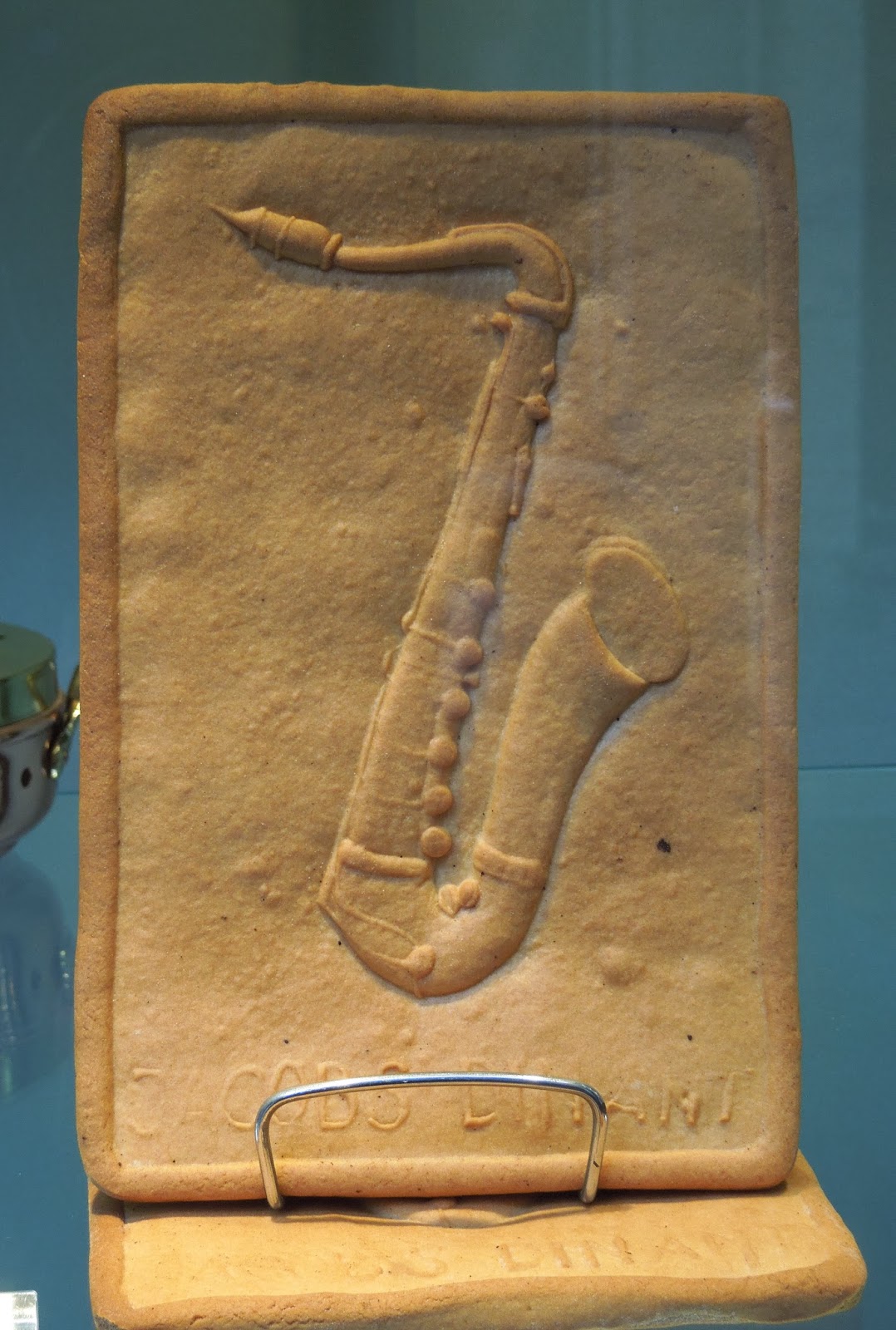


Saxophone Couque de Dinant


On Dinant's Rue Grande is an old bakery that sells sweet biscuits that the city is famous for: Couques de Dinant. Couques are traditionally molded into a variety of forms: animals, flowers, people…and saxophones! Maison Collard has been making these extremely hard honey-and-flour biscuits since 1774 (they are the hardest biscuits in Europe). In the back of the store there's a small museum dedicated to explaining the history and production of Couques de Dinant. 

The cookies come with a warning: customers are advised not to bite into them without first dipping the cookies in coffee, tea, or hot chocolate to soften them.


Why are Couques de Dinant so hard? One local story is that the citizens of Dinant didn't get along with their neighbors in Bouvignes (the next village). When disputes erupted the people of Dinant would throw their stale, hard bread and biscuits at the people of Bouvignes. To improve their weapon of choice, they created this special, very hard biscuit...to inflict more pain. 

You gotta love the Belgians. They come up with the best stories to explain the things they're famous for. 


A wide variety of Couques de Dinant to eat…or to hurl at your enemies

OK...so why are there all those saxophones in Dinant? It's because the saxophone was invented by one of Dinant's citizens-  Monsieur Sax. 


La Maison de Monsieur Sax
Adolphe Sax was born in Dinant in 1814. His father was an instrument designer who had some success making changes to the French Horn. By age 15 Adolphe was designing musical instruments, too. When he was 24 he patented an important improvement to the bass clarinet design. In 1841 he moved to Paris and worked on a new set of instruments there, including a family of saxhorns, the clarinet-bourdon, and the instrument he is most well known for, the saxophone (patented in 1846).

The house where Adolphe lived in Dinant is gone, but an "interpretive center" called La Maison de Monsieur Sax that tells about his life and work stands in its place. There are examples of his musical inventions- with sound effects! You can make a "virtual visit" to this cool little place by clicking on this link: 
http://www.visit-360.net/visites/maisonsax/virtualtour.html


If you'd like to have your picture taken with Monsieur Sax, you can snuggle up to a bronze statue of him that sits on a bench in front of La Maison de Monsieur Sax (he's holding a saxophone, of course).
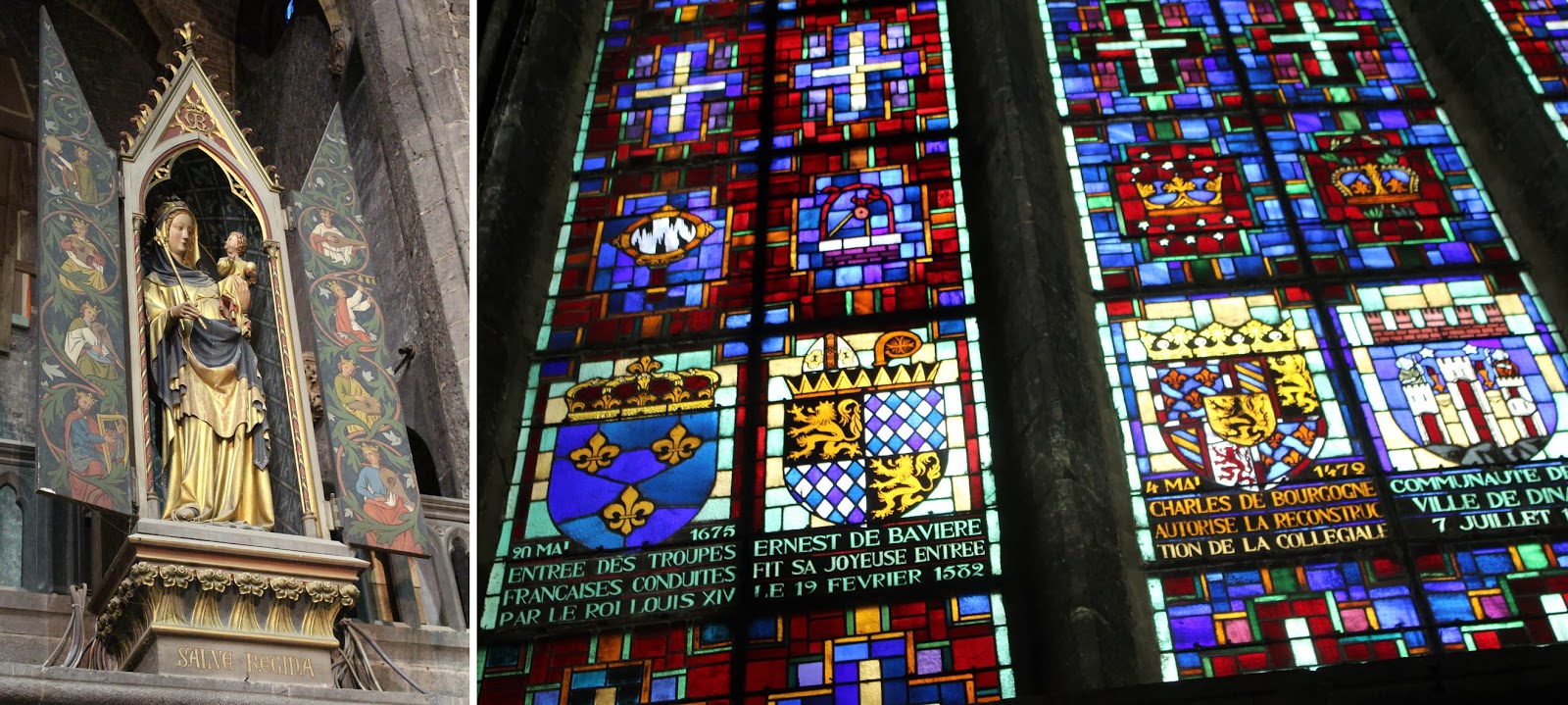


                                                                 Collegiale Notre Dame's 15th century stained glass
If you visit this nice little city there's lots more to see and do. Dinant has a lovely 13th century Gothic church, Collegiale Notre Dame (Church of Our Lady). Wonderful church treasures are on display in its dark, rough stone interior. Its stained glass windows are some of the most beautiful we've seen in our travels. 
Dinant's Citadel on a cliff above La Collegiale Notre Dame

Dinant is a long, narrow city, built below the soaring cliffs that border the Meuse. A Citadel sits on top, overlooking the river. The city's téléphérique (cable car) will take you to the top for a spectacular view of the city and river. Or you can climb the 408 steep steps to get there, if you're feeling energetic. It was raining hard the day we stopped in Dinant, so we skipped a trip to the top of the cliff.


Le Winston, a place to buy delicious frites


Instead, we found a great little friterie close to the river, near where we parked the car. We knew the pommes frites would be good, because Dinant is in the heart of the area where pommes frites were supposedly invented. The frites that we bought at Le Winston were THE BEST frites we've eaten during our European adventure. If you're ever in the neighborhood, be sure to stop in at Le Winston for a cornet de frites, with a hefty dollop of mayo.


Monday, December 16, 2013

Brussels: The Manneken Pis

Manneken Pis items for sale in Brussels

Every popular tourist destination has its own icon. New York City: the Statue of Liberty, Paris: the Eiffel Tower, Rome: the Colosseum, London: Big Ben, and Brussels: the Manneken Pis.
The what?
The Manneken Pis. Translated from the Brussels Marollien dialect, this is Little Man Pee- a two foot tall bronze statue of a chubby naked boy peeing. The Manneken Pis is perched in an alcove at the corner of Rue de l’Etuve and Rue du Chêne, a short walk from La Grand Place, the city’s main square. You know you’re there when you see Manneken Pis in neon letters, mounted above the street on a building that’s kitty-corner from the fountain. In nice weather the clientele of this Manneken Pis Cafe can enjoy watching the tourists ogle the Brussels landmark from their sidewalk tables.


The Manneken Pis is a fountain. The statue was designed by Hieronymus Duquesnoy the Elder, and placed here around 1619. 


But Brussels' original Manneken Pis statue has been repeatedly stolen, so what the tourists are looking at is a 1965 reproduction. The original restored statue is in a museum on La Grand Place. 

There are a numerous stories about the background of the statue. The most popular is about a two-year-old Belgian Duke who during a 12th century battle was suspended in a basket hung from a tree (to encourage his soldiers). The little Duke urinated on the opposing troops below, and the Duke’s troops won. A charming little story.
The water that streams out of the little guy’s...well, you know...falls into a basin below. On any day there will be a crowd of people gathered at this corner taking pictures of the little pisser.


On one corner across from the fountain we saw a man selling dishes of escargots (snails!) to the onlookers. Fast food a la Bruxelles. I thought this was just as interesting as the curious fountain! The escargots were delicious. But I don't think they'd sell well on the streets back in the USA.


You don’t have to go to the corner of Rue de l’Etuve and Rue du Chêne to see the Manneken Pis. He is everywhere in this city. Shops sell the little guy in many different forms. He appears as a lollipop, molded in chocolate or marzipan, and baked as a cookie. His image appears on t-shirts, tea towels, on dishes, on mugs, on miniature souvenir spoons, key chains, bottle openers, ashtrays, refrigerator magnets, cookie and candy tins, and just about anything else you can think of. There are Manneken Pis statues for sale in a variety of sizes and materials. 


You can purchase your own little Manneken Pis fountain to take home, if you wish. We found one of these on display outside a restaurant in one of the narrow pedestrian streets off the Grand Place. Instead of water, beer was flowing from the little fellow, into a giant beer glass. Appetizing.

The city often dresses the little guy in costume to celebrate special occasions. An official organization called The Friends of Manneken Pis is in charge of selecting what he'll wear, and the dressing ceremony is accompanied by a brass band. Serious business.


The Manneken Pis appears on billboards and signs throughout the city. Vending machines in the Brussels airport welcome travelers with psychedelic-style advertisements featuring the Mannekin Pis. He stands on top of a white Coca Cola bottle doing his thing. An arc of light curves from what he holds in his little hand, and into the coke bottle below. The advertisement invites us to taste the Coke side of Belgium. 


If you want an order of Manneken Pis flemish frites to go with that Belgian coke, you can find them in Amsterdam, at the Manneken Pis friterie on Dam Square. These have been voted the best pommes frites in Holland by Frietopia, a Dutch website dedicated to the search for the Netherlands' best fries. Would this sign entice me to eat their fries? I don't think so.


I'd be wary of the Manneken Pis coke, too. Perhaps the Belgians add a special ingredient... 


Vasa: a Warship in a Building!

Port side of the Warship Vasa
Stockholm has a unique museum that every visitor to this city should see. The Vasamuseet on the city's Djurgården island houses a HUGE 17th century Swedish warship that sank on August 10, 1628, at the start of her maiden voyage. It is a splendid ship, made from the wood of more than 1,000 oak trees. Vasa measures 226 feet long by 172 feet tall. It's quite an experience, entering the cavernous room where the enormous ship is housed. On first seeing Vasa I thought of the legendary ghost ship The Flying Dutchman. The low lighting in the museum added to the spookiness. 


Vasa's richly ornamented stern


King Gustvus Adolphus
In January 1625 Swedish King Gustavus Adolphus contracted with a Swedish shipyard to have the great warship Vasa built. Construction started in 1626 and was completed two years later. Unfortunately, Vasa's design was flawed. She was top heavy, and failed her first stability test. But that didn't stop her from sailing. It's incredible that she was allowed to leave the harbor, despite the doubts of some of the people in charge. 

Vasa sank twenty minutes after setting sail on that fateful summer day. A gust of wind filled her sails and caused the ship to heel sharply to the port side. The gun ports were still open and the cannons were out (after firing a salute as the ship left Stockholm). Water rushed in through the open gun ports, heeling the ship further. Vasa quickly sank in 105 feet of water, less than 400 feet from shore. At least 30 of the estimated 150 people on board perished in the wreck.


Vasa and most of its contents remained mired in the mud for 333 years. In 1956 an amateur archaeologist named Anders Franzen located the wreck. It took a recovery team five years to prepare the ship for its resurrection from the sea bottom. On April 24, 1961 the Warship Vasa was raised again in Stockholm's harbor. The story of reassembling all its pieces and preserving Vasa for all of us to see is amazing. You can learn more about it here: http://www.pkvirtual.com/virtual/prace/vasa1.pdf

Vasa's brightly colored 1:10 scale model


This richly ornamented regalskepp (royal ship) was to be a symbol of Swedish naval power. The many sculptures that decorate its exterior were meant to glorify the Swedish monarch and to intimidate Sweden's enemies. The colorful paint that covered the ship is gone now, but a scale model placed near the original ship shows what archaeologists believe Vasa looked like in 1628.

There were several levels of balconies surrounding the immense ship that made it easy to view its details from every angle. On one of the upper levels we stood at the balcony rail, seeing the original wooden sculptures of the stern up close. Displayed on a wall behind us were painted reproductions of the same sculptures. So beautiful!
Painted reproductions of Vasa's elaborate ornamentation


The officer's cabin


We arrived at the museum just one hour before closing, and weren't able to see all the exhibits related to the great ship. Most of our time there was spent circling the ship on the different balcony levels, drinking in the amazing spectacle. There was a full scale reproduction of one of the cannon decks that we could walk around in, and of the officer's cabin. 


Glass cases on one level held items found with the ship- ceramic pots and bowls, pewter tankards, cutlery, weapons- all sorts of things that outfitted the ship for its first voyage. Remarkably, some items of clothing survived in a closed trunk for the three-plus centuries that it was submerged, as did leather shoes that were found on the skeleton of a sailor who was trapped under a cannon. These were the things that reminded us that this wonderful museum is the result of a terrible tragedy. 

Sunday, December 15, 2013

Tomtegubbar Invasion

Lucia in a sea of Tomtegubbar at the Gamla Stan Julmarknad
Tomte outside a restaurant in Gamla Stan


Tomtegubbar is plural for tomte. The tomte is an elf who secretly lives in the Swedish house or farmyard, protecting animals and children, and bringing good luck to the family. But tomtegubbar are easily offended and will make mischief if they're displeased. To keep their tomte happy, Swedes should leave a bowl of porridge out for the him on Christmas night. The tomte is the guy who brings the Christmas gifts, so don't forget the porridge!


Looks like the Swedes love their tomtegubbar. Stockholm is full of them this December. They're everywhere!
The tiniest tomtegubbar we found in Stockholm


According to Wikipedia, "a tomte is no taller than three feet, and has a long white beard and colorful clothes.” We did see some three-foot tall tomtes, but most were smaller. The smallest were a shade over 1/4 inch tall. I bought some of these cute mini-tomtes to take home for friends. 


The majority of tomtegubbar are dressed in red, but you can find them outfitted in every color here, some with polka dots, stripes, or other patterns on their caps. A stall at the fantastic Skansen Julmarknad (Christmas market) offered the little elves in pastel outfits.
 Tomtegubbar in a variety of colored caps at the Skansen Julmarknad


The tomte is a popular decoration in Swedish store displays at this time of year. A lot of them have their pointed caps pulled down tight over their eyes. Probably because tomtegubbar are very shy and uncomfortable with all the shoppers looking at them...

A variety of  Tomtegubbar decorate store windows in Stockholm
Marzipan Tomtegubbar!


Tomtegubbar appear on greeting cards, dishes, tea towels, and in many other forms for sale at Christmastime. I bought a bag of tiny marzipan tomtes for a hefty price, in an elegant candy store near the Kungsträdgården (King's Garden, a park in central Stockholm). A unique Swedish Christmas treat to take to the friends back home.


Can you tell that I find tomtegubbar hard to resist? In addition to the mini-tomtes and marzipan tomtegubbar, I bought a really cute little red-capped tomte in a shop in Gamla Stan. He's about an inch tall, made of ceramic. This tomte is moving from Sweden to Coopersburg with us. The best possible souvenir of our trip to Stockholm: our own household tomte, to keep us safe and lucky.


Saturday, December 14, 2013

Gamla Stan: Stockholm's Old Town

Christmas Market on Stortorget, in Gamla Stan.


On our first day in Stockholm Jim and I walked all around Gamla Stan (the Old Town). Most of Gamla Stan is on Stadsholmen, one of the many islands that makes up the city. Its cobbled streets and medieval buildings date back to the 13th century. As we crossed one of the bridges to enter the Old Town the sun was setting (before 3 pm). We stopped on the old bridge to enjoy the spectacular sunset. What a treat. In Maastricht we don’t see sunsets like this. 


In Gamla Stan there is a small, beautiful Christmas Market on Stortorget, Stockholm’s oldest square. The stalls were selling handcrafted items, many of them from Sweden. Glögg was for sale at the Christmas Market, of course. Swedish glögg is sweeter than glühwein (and it tastes more fruity). This glögg had raisins and almonds in it.  A perfect drink on this very cold Stockholm day.


Glögg stand on Stortorget

The Nobel Museum


Stockholm’s Nobel Museum is at one end of Stortorget. Alfred Nobel was a Swedish engineer who invented dynamite. He made a fortune manufacturing his invention. Nobel donated the bulk of his money to establish five Nobel Prizes, which are announced each year on December 10th (the anniversary of his death). Each recipient, called a laureate, is given a gold medal, a diploma, and an award of money. 


Gamla Stan was lovely after dark. We explored the Old Town's narrow streets, stopping in a shop now and then to warm up. Many of the shops and restaurants place candle lanterns outside their doors, enticing customers to come in out of the cold. 


Before leaving Gamla Stan we drank coffee and ate lussekatter at a cozy little coffee shop on Jantorget, one of the Old Town's squares. The coffee was served in a glass! Swedish cool.


Coffee and lussekatte (a saffron bun)


Friday, December 13, 2013

December 13th: Saint Lucia Day in Stockholm

Lucia at Stockholm's Storkyrkan, December 13, 2013
Lussekatter for sale in a
Stockholm supermarket

On December 13th Sweden celebrates the feast day of St. Lucia, the patron saint of light. It’s easy to see why Lucia is so popular here in this land of winter darkness. As the winter solstice grows nearer, the hours of daylight get shorter (today, December 13th, the sun set at 2:46 pm in Stockholm). On this day in many Swedish homes, the eldest daughter of the household portrays Lucia, wearing a long white gown and a crown of evergreen and lighted candles. She rises before dawn and awakens the family with coffee and freshly baked traditional saffron buns called lussekatter. 


I learned about Sweden’s Lucia tradition many years ago attending a wonderful Lucia Fest pageant that was put on by the Church of St. James Kingsessing in Philadelphia. St. James is one of the old Swedish churches in the area, founded in 1760 by Swedish Lutheran missionaries. Jim and I went together to St. James' Lucia Fest. I was a college student at the time, and Jim was my new boyfriend! We loved this beautiful event so much that years later we helped start a Lucia Fest pageant at Muhlenberg College, where Jim teaches. Faculty and staff kids play the parts, and a local Scandinavian organization, the Viking Lodge #735, is our choir. This year Muhlenberg’s Lucia Fest was on December 1st- celebrating its 34th year! 


Muhlenberg College Lucia Fest, 2013

Gamla Stan Stjarngosse


We came to Stockholm to experience Lucia Day, and thanks to a Swedish lady named Ulla who sings in our Lucia Fest choir, we secured tickets to the beautiful Luciakonsert at Storkyrkan, Stockholm’s Cathedral in Gamla Stan. Ulla’s friend Lotta, who lives near Stockholm, bought the tickets for us. Before the concert we were to meet in front of the Nobel Museum in the Old Town. While we waited for Lotta, a young boy who was dressed as a Stjarngosse (Star Boy) was singing Lucia hymns on the steps of the museum. His voice was beautiful, as was the setting. When he finished his singing he blew out his candle and disappeared into the night…


When Lotta arrived we walked through the Old Town to Den Glydene Freden (The Golden Peace), one of Sweden's most well-known restaurants. It has been in business since 1722, and has remained pretty much unchanged since then. We started with delicious glögg in little glass cups, and then enjoyed a wonderful traditional meal of Swedish meatballs with lingonberry sauce.


Lotta leads us into Den Glydene Freden for a delicious meal of
Swedish meatballs and lingonberry sauce
Den Glydene Freden Lucia serenade


The interior of the restaurant is so beautiful, lots of wood paneling, lit by candlelight. Before we left we had a great surprise- Lucia appeared with her attendants and we were serenaded! 


Storkyrkan Lucia with Attendants and Stjarngosser


After dinner we walked uphill to the Cathedral through Gamla Stan's lantern lit streets. Inside the church we met Lotta's friend Inger. It was the first time either of them had been to Storkyrkan's Luciakonsert. Lotta had reserved great seats for us, close to the front of the Cathedral. The Luciakonsert choir was made up of students from two Stockholm Music schools. They were so amazing- sweet, clear voices that combined to make an absolutely heavenly sound in that wonderful place. They sang for nearly an hour and a half, with each child holding a lighted candle the whole time. Early on Lucia appeared in the center aisle, led by two violinists. She was breathtakingly beautiful, moving slowly towards the altar in her crown of glowing candles, accompanied by the music of the violins. She remained on the altar for a very long time- unmoving- lit by the flickering candles in her crown. 


At the end of the concert Lucia led the procession of singers down the center aisle. They were singing Sankta Lucia, an old song with a haunting melody. I was overwhelmed by the incredible beauty of the moment…I got a little weepy. Jim teased me about the tears (but told me I wasn't the only one weeping- lots of us were wiping our eyes). I will never forget the wonderful beauty of that scene, or the lovely voices that gave us the gift of this memorable experience.


Our new Swedish friends

When the Luciakonsert was over we wandered back through the streets of the Old Town and found a cozy tavern to share a bottle of red wine together. We had a great conversation in that place, and learned more about our new Swedish friends. We had only spent one evening in Stockholm with them, but after our magical Lucia experience at the Storkyrkan together, they felt like old friends…


I'll share another beautiful Lucia day experience I had in Stockholm with you: here's a video I made in Gamla Stan in the afternoon. Walking on one of the old cobbled streets I passed two girls who were standing in a doorway, singing Christmas songs. They wore Santa hats trimmed with silver tinsel garland, and they were holding lighted candles. I asked if they would sing Sankta Lucia. They were very happy to oblige, and delighted that I was going to film their song! Here it is, a lovely Lucia happening in Stockholm's Gamla Stan on December 13, 2013: