Thursday, September 10, 2015

Looking Up in Heidelberg

Strolling on the Hauptstrasse, in Heidelberg's Altstadt.
At the end of our Rhine cruise we headed for Heidelberg, home to Germany's oldest university (founded in 1386!) Heidelberg straddles the Necker River, a major tributary of the Rhine. It's a fun city to visit, with its many nice shops and cafes.


Schloss Heidelberg towers above the Altstadt (Old Town)

The picturesque Schloss Heidelberg is perched high up on a mountainside, overlooking this romantic city. Construction of the castle began in the 13th century. It was later destroyed by fire (two separate lightening strikes!) and a series of wars in the 17th and 18th centuries. Parts of the castle have been restored, but much of it remains a ruin. 


The Heidelberg Tun


The castle cellar is home to one of the ancient city's treasures- the Heidelberg Tun. The tun is a HUGE wine barrel, made in 1751. It has a capacity of nearly 58,000 gallons. Its wine-storing days are long gone. Now it's one of Heidelberg's major tourist attractions.


In Heidelberg I found myself always looking up! I had to look up to see the beautiful old castle ruin, of course, and to see the church towers high above the narrow streets. One afternoon when I was strolling on the Hauptstrasse, I looked up to see where bubbles floating through the air were coming from! A little mechanical bear was blowing them. He was perched on a red chair attached to a balcony railing above my head. There was no sign to explain why the bear was there, or why he was blowing bubbles. This mysterious bubbly bear was one more reason to love this charming city.


There were lots of other beautiful things to see on- and above- the streets of Heidelberg. High on the corner of one building I found beautiful mosaic portraits of famous German citizens. Religious statues adorned the corners of many other buildings. The Hauptstrasse Starbucks had a beautiful Madonna and Child sculpture on its corner. Not something you see at most Starbucks!
Most corner statues were of a religious nature. Some celebrated more down-to-earth pursuits:)

But the best part of visiting Heidelberg was the chance to see some of my friends who live nearby. Martin Ost brought his son Adrien into the city and we had a lekker snack at a very cool cafe called Urban Kitchen. Adrien is my godson. He was born in Pennsylvania while his parents were working in the states. Now they're back in Germany, so I don't get to see them so often.


Martin was wearing a "Johnny Cupcakes" t-shirt that I had bought him in Boston. He collects t-shirts, so every year I send him a few unique selections made in the USA.
I'm sure he's the only guy in Heidelberg who was wearing a Johnny Cupcakes t-shirt that day:-)


Before we left Urban Kitchen, Martin told me to check out their unusual rest rooms, so I did (taking my camera along!) A door labeled with a word that I guessed said "rest rooms" opened into a circular area with a large stone sink in the middle. Doors off of the circular washroom were cleverly labeled to indicate which were ladies' rooms, men's rooms...and whatever rooms:-) 

Das ist super cool. 


Sunday, September 6, 2015

Cruising on the Rhine, Engelbert Humperdinck Country

Jim's students enjoying a cruise on the Rhine.


It was a chilly August morning when we boarded the boat in Koblenz for our Rhine River cruise. The sun felt good when it finally gained strength during the second hour of our pleasant trip. A waiter brought us hot tea and croissants- a perfect snack for watching the Rhine River valley go by! 


We passed steep hillsides carpeted in vineyards, and quaint villages with half-timbered houses facing the river. Many of the villages had signs announcing their names. Larger towns like Boppard didn't display their names (as if everyone should know...that's Boppard!...no label necessary). We learned this scenic town's name because our boat stopped to pick up passengers- LOTS of passengers, it turned out. We were glad we had already staked our claim on a table with two chairs at the port side railing on the open top deck. 

Boppard's most famous inhabitant was Engelbert Humperdinck. No, not THAT Engelbert Humperdinck...the one who lived in Boppard in the late 1890s, a German composer famous for his opera Hansel and Gretel. The E. Humperdinck most of us are familiar with was a British singer named Arnold Dorsey, who adopted Humperdinck's name in 1965 ("Please Release Me" was one of his big hits). A street in Boppard is named after the original Engelbert Humperdinck (Humperdinckestrasse), and the proud citizens erected a monument to him. 
Boppard waterfront

We disembarked at Bad Salzig and found our bus waiting for us. Everyone held their breath as the mammoth vehicle climbed a steep switchback road to get us on the highway to head for Heidelberg. We were amazed- somehow our driver negotiated those sharp turns! From the top we had a wonderful view of the Rhine. We'd love to return and cruise a longer stretch of this beautiful, romantic river. 


Monday, August 24, 2015

Koblenz: Spitting Statues and a 6-Foot Thumb


The Deutsches Eck in Koblenz

Jim and I are on a "study tour" trip with his students. We started the 5-day adventure in Koblenz, Germany, a city situated at the confluence of the Rhine and Mosel Rivers (the French spell it Moselle). The narrow point of land in Koblenz that divides the rivers is called the Deutsches Eck (German Corner). A massive statue of Emperor Wilhelm I on horseback lords it over the Eck. On the day we visited, Wilhelm was being serenaded by an accordionist down near water level who was playing french cabaret tunes. Sweet.


Behind Wilhelm's statue there's a small park with beautiful gardens and large plane trees (like our sycamores). Some trees were decorated with colorful splotches of color! Nearby is a contemporary art museum- the Ludwig Museum. I wondered if the Museum had anything to do with the whimsical tree painting. There wasn't time to tour the inside of the museum, but we wandered around in its courtyard and came upon a 6-foot tall bronze sculpture of a thumb! The detail on this giant thumb was impressive, right down to its unique fingerprint. 


A huge fortress dominates the clifftop opposite the Deutsches Eck. This is Ehrenbreitstein, built by the Prussians between 1817 and 1828 to protect the middle Rhine area from French invaders. We rode a cable car that crossed high above the river to get to the fort. The views from our cable car were spectacular! That ride was one of the highlights of our short stay in Koblenz. Jim wasn't interested in walking about in the fortress, so I explored it myself. I forgot to get the fortress map from Jim, so I became lost in the huge walled in space and its confusing interior corridors. Eventually I found my way out and we rode the cable car back to the Deutsches Eck park where we lunched at a pleasant outdoor cafe near the Ludwig Museum. 


Wandering about in Koblenz' altstadt (old town), I found some unusual statues. The funniest is the Schangelbrunnen, a statue of a "spitting boy." At regular intervals a stream of water spurts from the little guy's mouth, pouring onto unsuspecting tourists. Created in 1940, this statue is a tribute to the mischievous youth of Koblenz. In another of the city's squares- Gorresplatz- a towering "history column" tells the story of this Rhineland town. At the bottom of the column is a boat filled with wine barrels, representing the success of Koblenz' wine trade. A huge head projects from the bow of the boat. Like the Schangelbrunnen, this fellow is also spitting water.


 Later in the day we joined the students for a wine tasting at the Hans Mader winery on the banks of the Mosel. It was a beautiful drive along the river to reach the winery. We marveled at the steep banks planted with grapevines. How did they tend the vines and harvest the grapes on those inclines? It was all explained to us by Hans' son, the 3rd generation winemaker in the family. The steep slopes make it impossible to use machinery for the process, so all of the work is done by hand. We tasted a number of wines, both red and white. Our hosts also served us a delicious Winzerplatte while we were tasting: cheese, ham, homemade sausage, and slices of brown Oberlander bread. A great way to end our afternoon in the Mosel valley! 


Friday, August 21, 2015

Star-Studded Maastricht

A huge star in the ancient city center welcomes tourists to Maastricht


Maastricht VVV building once served
as a courthouse (Dinghuis)
There's an image identified as Maastricht's flag in a book called the Wappenbuch von Meister, published in Germany in 1545. It shows a man holding a red flag with a white star in the center. In 1994 a modern version of the old original Maastricht flag was introduced. 

The Gemeente Maastricht (Municipality of Maastricht) is proud of its beautiful flag, and has adopted the star as a symbol of the city. You'll see red and white stars displayed everywhere here. A good place to find a selection of these Maastricht stars is the city's tourist office, or "VVV" (short for Vereniging Voor Vreemdelingenverkeer, which means "Association for the Traffic of Foreigners." Sounds like a rogue kidnapping organization! The VVV is housed in a beautiful old building dating to 1470. Originally it was Maastricht's Dinghuis (courthouse).


The VVV sells maps, books about Maastricht and Limburg province, and products made in Maastricht (including appelstroop, a molasses-like syrup made from apples). And then there are the STARS...star keychains, refrigerator magnets, and red pens imprinted with a white Maastricht star. To my delight, I found bags of chocolate stars!


Maastricht's VVV offers a variety of star themed items for sale.


Maastricht's most famous star is its talented native son, Andre Rieu. Rieu is a violinist, known for creating and conducting the Johann Strauss Orchestra that is well-known for its worldwide touring act. Every summer Rieu returns to Maastricht to host a city-wide party centered around a week of the orchestra's concerts. The main stage is in the Vrijthof, Maastricht's largest square. The VVV sells CDs of Andre Rieu's music, of course. They also sell cute little keychains with Andre's image, backed by the ubiquitous Maastricht star! I bought one to bring to a Dutch friend back in the states who was the first person to tell me about this famous Maastrichtenaar.


Maastricht stars pop up in some unusual places. Last week my Dutch friend Ria took me to the grocery store, and while we were there I bought "official" Gemeente Maastricht trash bags. It's mandatory to put your trash in one of these special bags. The price of the pickup is included in the hefty price of the plastic sack. Trash pickup is on Wednesday in our neighborhood, the Jekerquartier. On Tuesday evening I opened the package of Gemeente Maastricht official trash bags. There were those Maastricht sterren again! This time white stars on a red field with the Maastricht logo and RESTAFVAL (waste) printed large. 


Classy trash bags for a classy city.


Sunday, August 16, 2015

Return to Maastricht

The fireplace doesn't work, but it is lovely to look at!
Our beautiful, gezellig living room.
  

We're back in Maastricht! Our view is no longer from Sint Pieterstraat, but it is still a lovely view from the windows of our apartment. We live in a very old building, on what we believe to be the most beautiful square in Maastricht. It's great to be back here and to see that the Maastricht we got to know in 2013 has not changed much! All of our favorite cafes are still in business, as well as most of the shops we grew to love. It's still a LONG walk to the grocery store. Lugging all that good Dutch and Belgian beer home can be difficult:-) Right now it's time for me to head out to Albert Heijn (one of our supermarkets) to find something for dinner. No cafe dinner for us tonight, too many people in town! 

Life is good. 


Tuesday, March 4, 2014

Maastricht: New Lives for Old Churches


Polare Bookstore,  a religious experience for Dutch book lovers.

Over the past 50 years the Netherlands has experienced a dramatic drop in religious practice. Catholicism was traditionally the country's predominant religion, and at one time its Catholic church attendance was the highest in Europe. In the 1970s the Dutch population was 40 percent Catholic, but today only 24 percent identify themselves as Catholic. And many of those who say they are Roman Catholic do not regularly attend church. As a result of the shrinking attendance, hundreds of Catholic churches in the Netherlands have been shut or sold. The enterprising Dutch have found creative new uses for these historic buildings.


Maastricht has many re-purposed church buildings. Some house offices and apartments. A Franciscan church close to where we lived now holds the Limburg state archives. A 15th century monastery and church complex near the Vrijthof has been made into a beautiful high-end "designer hotel" called the Kruisherenhotel. 


Chic lobby of Maastricht's Kruisherenhotel.


A former Dominican church in the center of Maastricht has been transformed into a spectacular bookstore. This church was not one of the casualties of the recent decline in Dutch religiosity. It was consecrated in 1294, but it hasn't been used for religious services since 1794. That's when Napoleon's army confiscated the property for military use. The gothic building has also been used as a town archive, a warehouse, and even for bike storage. In 2005 it was reincarnated as a bookstore, now called Polare.


Coffee Lovers cafe at Polaris


A popular cafe called Coffee Lovers occupies the area where the church's altar once was. Sleek black metal book stacks rise three levels above the floor of the nave. From the book stack's top balcony there's a great view of the crucifix-shaped table in the center of the cafe- a modern day altar where coffee worshippers can use the free wifi or meet with friends. We didn't find many books in English at Polare, but it was still a fun place to visit. 


The most unusual use of an old church that we found in Maastricht was on the Kesselkade, near the river. A somber looking Augustinian church there has been made into an indoor playground called Funville. A 30+ foot tall structure inside the church contains trampolines, ladders, and slides of varying heights for kids to enjoy. Parents can relax in a cafe lounge to watch their kids play (there's free wifi, of course). Church has never been so much fun.


An indoor playground in a former church- heaven for kids.

Funville's mammoth slide


Friday, February 14, 2014

Florence Revisited

Florence viewed from the Piazzale Michelangelo
The last time I was in Florence was during my junior year in college, when I spent a semester studying art in that wonderful city. I left there in the beginning of May to hitchhike around Europe with a friend. My last look at Florence was the view from Piazzale Michelangelo. It broke my heart to leave, but I knew I'd be back. 

I didn't expect it to take so long for my return.

Florence's famous Ponte Vecchio (Old Bridge) spans the Arno River

Basilica di Santa Maria del Fiore
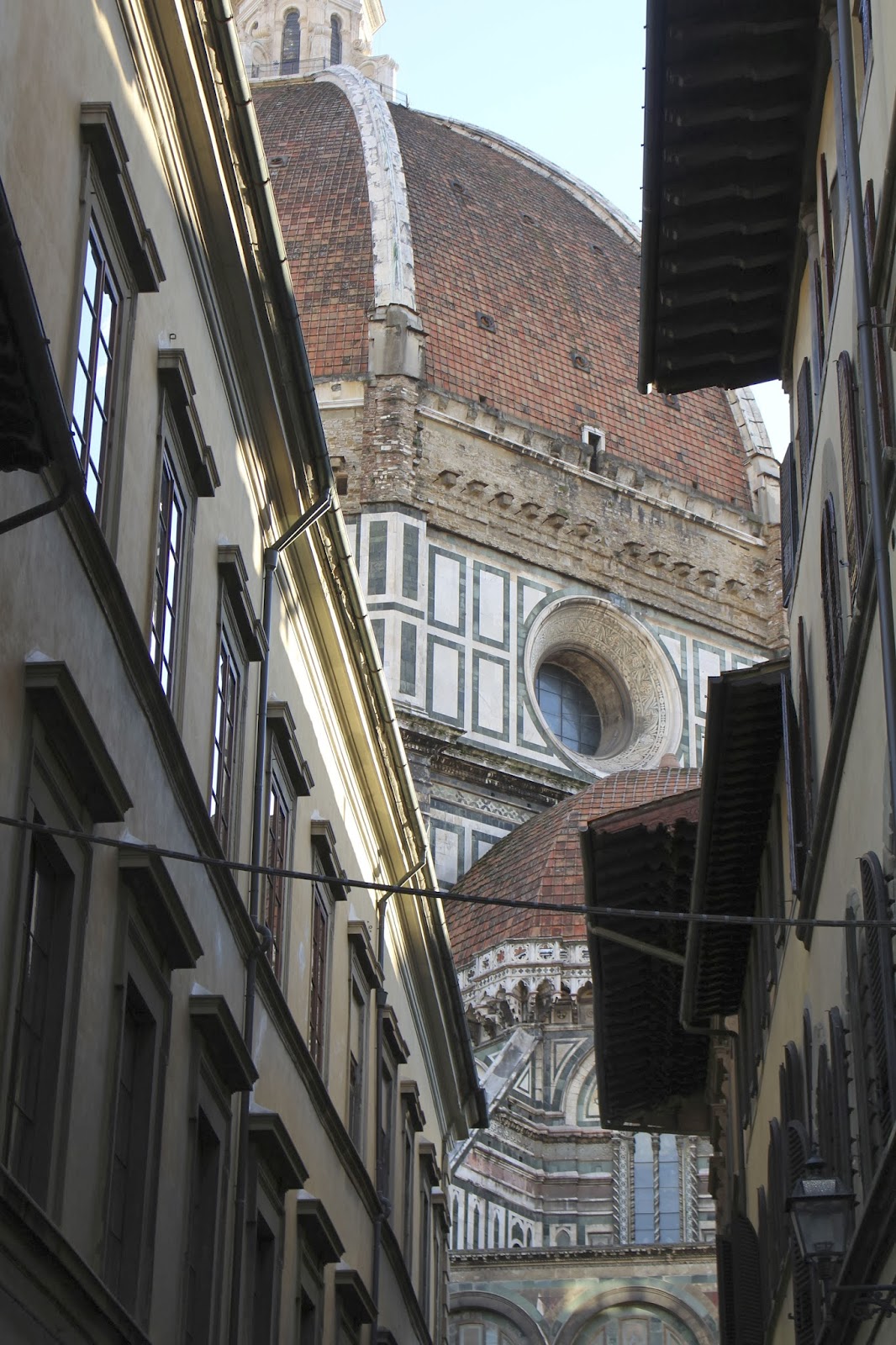
After a week at the Tenuta di Spannocchia, near Siena, I said goodbye to my watercolor workshop friends and checked into a hotel in the heart of Florence. It was a short walk to the Piazza del Duomo, where the huge orange-tiled dome of the  Basilica di Santa Maria del Fiore (St. Mary of the Flower) looms above the square. Looking up at the dome and the massive concoction of white, green, and pink marble that it crowns, I remembered how overwhelmed I was the first time I saw Santa Maria del Fiore. Until then I had never seen a church that was covered in anything but wood, brick or stone. And I had never seen a church so massive in size! It was so big, so beautiful, and so exotic. Since then I've traveled a lot, and have seen many huge, beautiful churches. But seeing this magnificent church still has a powerful effect.


As a student I had climbed up into that beautiful dome- designed by Filippo Bruelleschi in the early 15th century. It's still the largest masonry dome ever built! The view of Florence from up there was wonderful. I wouldn't go up in the dome this trip. The line to enter the cathedral was too long. There were a lot of other places I wanted to revisit in Florence. Waiting in line would waste precious time. 
My Via Pier Capponi home


Visiting my old neighborhood was a top priority. As a student I had lived in a big house on Via Pier Capponi, near Piazza della Libertà. An elderly Contessa rented rooms in the house, which was her home. My room was in the front of the building, with a balcony overlooking the street. When I returned to Florence last October, I found the house easily and was happy to see that it's well taken care of. It appears that the building has been made into apartments. 


Via Dei Servi, approaching the Duomo


I followed the same route back from Via Pier Capponi to the Duomo that I had walked so many times all those years ago. I wanted to relive the thrill of seeing the surreal vision of the marble Duomo looming at the end of narrow Via dei Servi. It is just as beautiful as I remembered.


Birth of Venus detail

On Sunday I spent two hours in the wonderful Uffizi Galleries. The place was mobbed. The museum has a very large collection of religious paintings. I saw numerous adorations, crucifixions, annunciations, and Madonnas with children painted by a variety of Medieval and Renaissance artists. It was a relief to finally come upon Sandro Botticelli's beautiful Birth of Venus, a non-religious painting that (by a stroke of luck) was not mobbed by a tour group when I entered the room. 


The broad windowed hallways and stone stairwells of the Uffizi were not so crowded, and they held plenty of artworks to enjoy. Many were sculptures and portraits of prominent Florentines. I was amazed by how unflattering some of the portraits were! Lots of big, unusual noses. Maybe the fellow in this portrait was proud of his huge crooked nose.


One of my favorites was this sculpted portrait of a cardinal. A profile only a mother could love.


Michelangelo's David


When I was studying in Florence, I was able visit the David statue in the Galleria del'Academia often, using my student pass. In the winter months there was no waiting line. Sometimes I'd be the only person there, drinking in the beauty of Michelangelo's masterpiece in its tranquil setting. This time I had to share David with a multitude, all of us looking up in admiration at the marvel that Michelangelo carved out of a single piece of white marble. 


The Basilica di Santa Croce
Thanks to my Italian conversation group friends Walter and Sharon (who met in Florence, and lived there for a time in the 1970s), I had a Florentine guide for three mornings. His name is Massimo- "Max" for short. Max has lived in Florence all his life. He and Walter became good friends while working as tour guides in the city's famous Scuola del Cuoio (Leather School) at the Monastery of the Basilica di Santa Croce (Basilica of the Holy Cross). One morning I met Max at Santa Croce, which is the world's largest Franciscan church. 


Michelangelo's tomb in Santa Croce


The tombs of some Florentine greats are in Santa Croce, including those of Machiavelli, Galileo, and Michelangelo. Michelangelo had promised his body to Florence, but he died in Rome. His body was stolen from Rome and smuggled to Florence in a horse cart! The Pope, who wished to bury the famous sculptor in Rome, was not happy with the theft. But he allowed Florence to keep Michelangelo's remains.


Santa Croce's Chapel of the Novitiate


The Basilica of Santa Croce has sixteen chapels. Walter and Sharon were married in one of them- the 15th century Chapel of the Novitiate, which was built for Cosimo di Medici. A beautiful Della Robbia glazed terra-cotta altarpiece adorns the wall above the altar. What a romantic setting for a wedding.


15th century fresco above the corridor entrance


After Max and I toured the church and its lovely cloisters we visited the leather school. The scuola is housed in Santa Croce's former Franciscan Monastery. Its main corridor is decorated with 15th century frescoes and coats of arms of the Medici family who donated this wing to the friars. In the corridor we met Francesca Gori, a daughter of the leather school's founder. She was delighted to see Max, and arranged a VIP tour for us! 


A young leather worker gave us a demonstration of hand tooled embossing on a leather tray, using gold leaf and ancient tools from the scuola's collection. His work table was at the far end of the corridor. At the other end of the corridor, glass cases held samples of the beautiful- and VERY expensive- handmade leather goods that the scuola produces.


A mountain of fruit in the Mercato Centrale


The next morning Max took me to Florence's huge Mercato Centrale for a panino con il lampredotto. Florentines have been enjoying this specialty since the 1500s. Sharon and Walter had raved about lampredotto, which is made from the "fourth and final" stomach of a cow. I was curious, and asked Max where I could find this culinary treat. He took me to Nerbone's, a food stall in the Mercato that has been serving lampredotto since the market opened its doors in the 1870s. The lampredotto was served with green chili sauce. Max insisted that we have a glass of red wine with it (at 11 in the morning!) It was an unusual, delicious lunch!


Nerbone's, and its famous panino con il lampredotto
Max at Pasticceria Sieni


After the lampredotto lunch, Max took me to another great Florentine hangout, the Pasticceria Sieni. He said it was one of the best cafes in Florence for a good cappuccino. 
I wasn't disappointed. 

Max was a great guide, and lot of fun. Walter and Sharon and I hope that he'll come to Pennsylvania sometime so we can show him around, and introduce him to some of our local culinary treats- like scrapple :-)


The Palazzo Vecchio


On my last evening in Florence I returned to see the Duomo, and to the Piazza della Signoria for a last look at the beautiful Palazzo Vecchio- the "Old Palace" that serves as the city hall. The ancient buildings were gorgeous at night, lit up and glowing against the night sky. I was sad, having to say goodbye to Florence again. But the beauty of this Renaissance city at night washed away those feelings.

There's an old saying- you can't go back again- meaning that the experience is never as good when you return to a place that played an important role in your past. The saying didn't hold true for me this time. I enjoyed every moment of my return visit to Florence. 

And I'll be back, beautiful Florence...I promise.